
Sebi's probe against Jane Street is part of its efforts to mitigate losses for individual derivative traders.

About 2.2 million new dematerialised (demat) accounts were opened in May, raising the total to 196.6 million as stock prices continued their upward trend.

The interplay between domestic and foreign capital will shape India's equity markets.

Without changes to the taxation rules, buybacks are expected to remain scarce.

One97 Communications Ltd (OCL), the company that operates the Paytm brand, posted a consolidated loss of Rs 539.8 crore in the fourth quarter of 2024-25 (Q4FY25), slightly lower from the Rs 549.6 crore it reported in Q4FY24. Sequentially, the fintech company's loss widened from Rs 208.3 crore in Q3FY25 on account of a one-time exceptional expense amounting to Rs 522 crore during the quarter ended March 2025.

Anmol Singh Jaggi and Puneet Singh Jaggi, once hailed as rising stars in India's clean energy sector, are now facing serious regulatory action.

Indian equity benchmarks rose nearly 2 per cent on Thursday, capping a truncated trading week with their strongest weekly performance in over four years. The rally was sparked by renewed risk-on sentiment following progress in trade negotiations and expanded tariff exemptions.

An hour-long disruption could affect around 40 million UPI transactions.

Industry players said the sharp sell-off in February forced many companies to put off their listing plans

The US Trade Representative noted that India's average applied tariff rate stood at 17% per cent, the highest of any major world economy.

Fundraising by Indian companies through equity and debt reached an all-time high in the financial year 2024-25 (FY25), according to data collated by primedatabase.com. Fundraising through debt stood at Rs 11.1 trillion in FY25, including contributions from InvITs (infrastructure investment trusts) and REITs (real estate investment trusts).

'The introduction of a reasonable MDR for large merchant transactions will allow the industry to continue investing in innovation, cybersecurity, grievance redressal, and merchant support, ultimately ensuring that UPI continues to thrive.'

The equity benchmark indices posted their strongest weekly gains in years, driven by bargain hunting and optimism over a reversal in foreign portfolio investor (FPI) outflows. The Sensex rose 558 points, or 0.7 per cent, on Friday to close at 76,906, while the Nifty 50 gained 160 points to end at 23,350. Over the past five sessions, both indices advanced around 4.3 per cent - marking the Sensex's best weekly performance since July 22, 2022, and the Nifty 50's strongest rally since February 5, 2021.

'The only solution is for the government to allow us to charge a low controlled MDR of 25 bps on UPI P2M transactions only for merchants with more than a Rs 40 lakh turnover.'

Since October, FPIs have offloaded Indian equities worth Rs 2.1 trillion.

The entire construction of the Navi Mumbai airport project is expected to be completed in five phases.
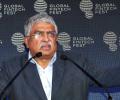
'Binary fission will happen -- startups will lead to more startups.'

618 companies were part of the billion dollar club when the markets reached all-time highs on September 26, 2024. That number has fallen to 500 following a $1 trillion wipeout in India's market capitalisation amid relentless selling by FPIs.

It is the first airport in the country to have multi-modal connectivity. This includes a linkage to the project via road, rail, and a metro system.

'Even if India is attractive, FPIs currently lack the funds to invest, as money is being redirected to the US.'
 © 2026 Rediff.com - Investor Information - Advertise with us - Disclaimer - Privacy Policy - Sitemap - Feedback - About us - Terms of use - Grievances